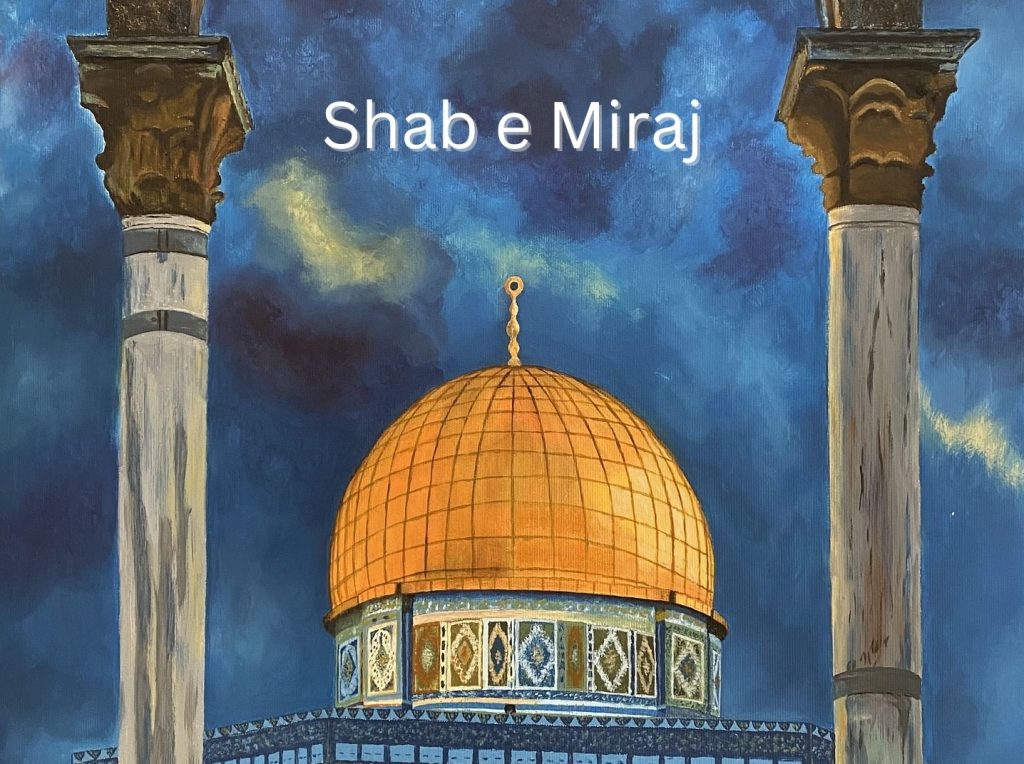
Shabae Meraj 2026 (Night of Ascension) is a holy day in Islam, commemorating the miraculous ascension of the Prophet Muhammad (peace be upon him). This night of the 27th of Rajab took place “Isra”, where the Prophet (PBUH) traveled from Makkah to Jerusalem, and “Meraj”, where he crossed the seven heavens and reached the presence of Allah. This night symbolizes the unity of faith, the importance of Salat (prayer), and the spiritual relationship between humans and their Creator. Muslims seek Allah’s mercy and guidance through worship, prayer and meditation on this night.
Shab e Meraj 2026
When is Shab e Meraj 2026
Shab e Meraj (Isra & Miʿraj) in 2026 is expected to be on Friday, 16 January 2026 (starting at sunset on Thursday, 15 January)
What is Isra and Meraj?

Shabae Miraj or “Rajni of Ascension” is the holy night on which the beloved Prophet Muhammad (pbuh) was taken by Allah from Masjid al-Haram in Makkah to Masjid al-Aqsa in Jerusalem, and from there he ascended to heaven. This miraculous journey is divided into two parts-Isra (the night journey from Mecca to Jerusalem) and Miraj (ascension). This blessed journey has immense spiritual significance, because it is on this journey that Allah Ta’ala makes five daily prayers obligatory for the Muslim Ummah, which is established as one of the fundamental foundations of Islamic worship.
See more: Beautiful Ramadan Mubarak Images
Significance
Shaba Miraj (The Ascension Day) is one of the most spiritually significant nights in the Islamic calendar, commemorating the miraculous ascension of the Prophet Muhammad (PBUH). This amazing event is believed to have taken place on the 27th night of the Islamic month of Rajab, a time of great prestige and deep significance for Muslims around the world.
In Islamic narration this event takes place in two stages -Isra and Miraj.
During the Isra period, the beloved Prophet (PBUH) was made by Allah to travel from Masjid al-Haram in Makkah to Masjid al-Aqsa in Jerusalem, where he ascended the celestial vehicle called Buraq. The visit is considered a symbol of the sanctity of Jerusalem in Islam and the unity of the Abrahamic religions.
The Prophet (PBUH) ascended to the sky during Miraj. Led by the angel Gabriel (a.s.), he crossed the seven heavens and met various prophets there, such as Adam (a.s.), Ibrahim (a.s.), Moses (a.s.), and Jesus (a.s.). Finally he reached Sidratul Muntaha – the tree of the nearest limit to Allah. It is at this holy moment that Allah Ta’ala makes five daily prayers obligatory for the Muslim Ummah, which carries deep significance in both the spiritual and practical aspects of Islamic life.
Shabbat Miraj is a night of self-criticism, worship and gratitude. On this night, Muslims engage in prayer, recitation of the Qur’an and supplication, asking for God’s mercy and forgiveness. This night reminds us of God’s infinite mercy, the importance of prayer, and the spiritual journey of every believer—through which he strives to get closer to his Creator.
Shab e Meraj History

Deep silence of the night. Allah’s Beloved Prophet Muhammad (peace be upon him) was reclining in the Hatim part of the Kaaba, near the Hazret Aswad (Black Stone). Just at that time the angel Gabriel (Alaihis Salam) arrived. He opened the bosom of the Prophet (PBUH) and purified it with Zamzam water in a golden vessel, which was filled with faith. Some narrations mention that it was washed with faith.
This miracle happened once before, when the Prophet (PBUH) was a child and in the house of his nurse Halimah (RA). Scholars say that this purification of the heart was done to strengthen and strengthen the heart of the Prophet, as he was about to witness such wonderful and profound realities, which a common man would have lost his mental balance upon seeing.
سُبْحَـٰنَ ٱلَّذِىٓ أَسْرَىٰ بِعَبْدِهِۦ لَيْلًۭا مِّنَ ٱلْمَسْجِدِ ٱلْحَرَامِ إِلَى ٱلْمَسْجِدِ ٱلْأَقْصَا ٱلَّذِى بَـٰرَكْنَا حَوْلَهُۥ لِنُرِيَهُۥ مِنْ ءَايَـٰتِنَآ ۚ إِنَّهُۥ هُوَ ٱلسَّمِيعُ ٱلْبَصِيرُ ١
“Glory be to Him who took His servant (Muhammad) by night from Al-Masjid Al-Haram to Al-Masjid Al-Aqsa, whose surroundings We have blessed, to show him of Our signs. Indeed, He is the All-Hearing, the All-Seeing.” Surah Al-Isra (17:1)
Sahih al-Bukhari (Volume 4, Book 54, Hadith 429)
The Prophet (peace be upon him) said:
“Then he (Jibreel) took me to the heavens, and we ascended to the lowest heaven…”
Then the angel Gabriel (peace be upon him) brought a creature to the Prophet (peace be upon him). It was a bright white animal, larger than a donkey but smaller than a mule, named “Burak”. This vehicle was prepared for the visit of the Prophet (PBUH). Accompanied by the angel Gabriel (a.s.), and some narrations mention that the angel Michael (a.s.) was also present—they embarked on the journey to Buraq together.
“The Prophet (peace be upon him) said: ‘I was brought al-Buraq, an animal white and long, larger than a donkey but smaller than a mule, which would place its hoof at a distance equal to the range of its vision.’”
Jami` at-Tirmidhi (Hadith 3133)
The Prophet (peace and blessings of Allah be upon him) described the motion of Buraq as beyond the range of sight. Its speed was so fast that it was beyond the capabilities of today’s modern technology. But scholars differ on the nature of Burak—some believe it could have flown. In fact, Burak did not fly, rather he ran from Masjid al-Haram to Masjid al-Aqsa. It was a unique creature, the likes of which no human had ever seen before.
“While he was in the highest part of the horizon. Then he approached and came closer, and was at a distance of two bow lengths or nearer. And He revealed to His servant what He revealed. The heart did not lie [about] what it saw. So will you dispute with him over what he saw? And he certainly saw him in another descent, at the Lote Tree of the Utmost Boundary – near it is the Garden of Refuge – when there covered the Lote Tree that which covered [it]. The sight did not swerve, nor did it transgress [its limit]. He certainly saw of the greatest signs of his Lord.”

On the way, the Prophet (peace and blessings of Allah be upon him) met an old woman, a summoning object and an animal, who greeted him. He offered prayers at three places on the way —
The first was in Madinah, where he was told, “This will be your place of emigration”;
the second at Mount Tur (Mount Sinai), where Moses (peace be upon him) spoke to Allah;
And the third is in Baitul Maqdis (Jerusalem), where Jesus (peace be upon him) was born.

On reaching Baitul Maqdis, the Prophet (PBUH) tied Buraq to the iron ring that previous Prophets also used to tie their vehicles.
The call to prayer was then given, and Gabriel (Alaihis Salam) appointed the Prophet (PBUH) as Imam. From Adam (A.S.) until the Day of Resurrection, all the Prophets who were sent, all prayed behind him.
The Prophet (peace be upon him) said he saw Musa (a.s.) there, who was tall, well-built and of the appearance of the people of the tribe of Shanu’ah. He also saw Isa (a.s.), whose complexion was light red, hair slightly wet and slightly shorter than Musa (a.s.). At last he saw Ibrahim (a.s.), whose appearance was very similar to that of the Prophet (s.a.w.).
Then Jibraeel (a.s.) presented two vessels before the Prophet (s.a.w.) — one containing milk, and the other containing wine (alcohol was not forbidden at that time). Jibraeel (a.s.) said, “Choose what you want for yourself and your Ummah.” The Prophet (pbuh) chose milk, then Gabriel (pbuh) said,
“You have chosen the best for yourself and your Ummah.”
With this announcement, the first phase of this miraculous visit of the Prophet (PBUH) came to an end.
Sahih Muslim (Book 1, Hadith 309)
“The Messenger of Allah (peace and blessings be upon him) was brought a vessel of wine and a vessel of milk. He chose the milk, and Jibreel said, ‘You have chosen the fitrah (natural disposition).’”
Then began the second phase of the Prophet’s (peace and blessings of Allah be upon him) journey, known as Miraj. The Prophet (peace be upon him) said, the gates of heaven were opened for him, and he ascended to the heavens with Gabriel (alayhis salam).
Allah Ta’ala says in Surah Al-Mulk (67:5) —
“I have adorned the nearest heaven with lamps (stars).”
Up to this nearest sky is the limit of human vision and knowledge. The next heavens are vast and unimaginable, where no one has access except by Allah’s permission.
The Prophet (PBUH) met Adam (PBUH) in the first heaven. Adam (a.s.) greeted him and said,
“Welcome, O Holy Son, O Holy Prophet.”
Then he traversed the next heavens step by step and met various prophets —
In the second heaven: Yahya (a.s.) and Jesus (a.s.),
In the third heaven: Yusuf (A.S.), about whom the Prophet (S.A.W.) said —
“He is given half of all beauty.”
In the fourth heaven: Idris (a.s.),
In the fifth heaven: Harun (as),
In the sixth heaven: Musa (pbuh),
And in the seventh heaven: Ibrahim (a.s.), who was reclining beside Baitul Ma’mur.
Every Prophet saluted him and showed him respect.
The Prophet (peace be upon him) said, he prayed at Baitul Ma’mur, where seventy thousand angels perform Tawaf every day, and once they perform Tawaf, they never return.

Spiritual Insights of Isra and Miraj
The visit of Isra and Miraj is not only a miracle, but it carries a profound spiritual teaching that transcends time and space and guides the development of faith, self-purification and social life.
This astonishing event reveals the depth of Allah’s infinite wisdom, the exalted dignity of the human soul, and the central role of the Prophet Muhammad (peace and blessings of Allah be upon him) as a spiritual guide for humanity.
1. Unity of Faiths and the Connection to Prophetic Tradition
Isra, i.e. the journey of the Prophet (peace be upon him) from Masjid al-Haram to Masjid al-Aqsa, symbolizes the spiritual and historical connection between the Abrahamic religions.
When the Prophet (PBUH) led the previous prophets on this journey, he declared that Islam is the fulfillment of all previous divine messages, and is a reflection of the unity and continuity of God’s message — an eternal guidance for all mankind.
2. The Infinite Mercy of Allah
This visit reflects the infinite mercy and grace of Allah Ta’ala, as the Prophet (peace and blessings of Allah be upon him) was honored with this glorious experience at a very difficult time in his life — that is, after the ‘Amul Huzan’ (Year of Sorrow).
It teaches us that Allah the Exalted comforts and reassures His servants in times of distress and distress, and calls us to have unswerving trust in His wisdom and decisions.
3. Elevation Through Worship
Miraj, i.e. ascension, clearly illustrates the transformative power of worship. The Prophet’s (peace be upon him) direct dialogue with Allah reminds us that Salat (prayer) — prescribed as a gift to the Ummah during this holy event — is a spiritual mirage for every believer.
Through prayer the servant establishes a direct connection with his Creator, and his soul transcends the limitations of the world and rises to a higher spiritual level.
4. Stages of Spiritual Growth
The journey through the seven heavens reflects the stages of a believer’s spiritual development. Encounters with different prophets symbolize different aspects of faith, such as patience, gratitude, sacrifice and surrender. It serves as a guide for the believers to attain self-purification and nearness to Allah, providing them with spiritual teachings and guidance at every step of their lives.
5. The Central Role of Salah
Mandating five daily prayers during Miraj highlights the importance of prayer as the cornerstone of Muslim life. Prayer serves as a means of direct connection with Allah, a regular reminder of His presence, and a powerful tool for self-discipline and spiritual renewal.
6. Understanding the Temporal and Eternal
Isra and Miraj reflect the interconnectedness between the earth and the sky. It encourages believers to maintain a balance between life’s worldly responsibilities and spiritual aspirations, and implies that true success comes only when a person aligns his life with God’s will.
7. Hope and Resilience
This incident teaches us to maintain stability and patience in the face of trials and tribulations. Just as the Prophet (peace and blessings of Allah be upon him) was spiritually uplifted after going through difficult times, believers are reminded that toil and suffering are temporary, and often contribute to spiritual rewards and the path to nearness to Allah.
Isra and Miraj inspire Muslims to gain deeper spiritual knowledge, strengthen their relationship with Allah, and reflect the values of patience, unity, and devotion in their daily lives.
Prophet’s Ascension to Heavens
Following the prayer at Masjid Al-Aqsa, the second phase of the journey began as the Prophet (S.A.W.) ascended through the seven heavens, meeting notable prophets at each level:
- First Heaven: Prophet Adam (A.S.)
- Second Heaven: Prophets Isa (A.S.) and Yahya (A.S.)
- Third Heaven: Prophet Yusuf (A.S.)
- Fourth Heaven: Prophet Idris (A.S.)
- Fifth Heaven: Prophet Haroon (A.S.)
- Sixth Heaven: Prophet Musa (A.S.)
- Seventh Heaven: Prophet Ibrahim (A.S.)
At the highest level, the Prophet (may peace be upon him) is shown Al-Baytul Ma’mur, a holy place of worship for the angels. He then reached Sidratul Muntaha, a boundary beyond which no creature could enter.
Here the Prophet (PBUH) was brought closest to Allah, but did not have the privilege of seeing Allah directly. This is mentioned in the hadith, which was narrated from Aisha (RA).
See more: Best Islamic Images in 4K & HD | 3D Wallpaper – Free Download
The Ordination of Five Daily Prayers
During this journey, Allah first made fifty prayers obligatory for Muslims. However, following the advice of Musa (Alaihis Salam), the Prophet (Sallallahu Alaihi Wasallam) repeatedly prayed to Allah to reduce the number of prayers. Finally, the number of prayers was reduced to five, but these five prayers would count as equivalent to the reward of fifty prayers—this was God’s assurance.
Gifts of Isra and Miraj
Aside from the gift of the five daily prayers, Prophet Muhammad (S.A.W.) was also given two other significant gifts:
- The concluding verses of Surah Al-Baqarah.
- Allah’s assurance that the sins of the Muslim Ummah would be forgiven, except for those who die associating partners with Allah.
The Prophet’s Return to Makkah
After completing this miraculous journey, the Prophet (peace be upon him) returned to Makkah the same night. The next day, he shared his experience with the people of Makkah. Many infidels ridiculed the Prophet (PBUH), but his close companion Abu Bakr (RA) recognized this fact and confirmed the words of the Prophet (PBUH) as true, thereby giving him the title of As-Siddhiq (Truthful).
Conclusion
Shabae Miraj is a miracle that has deep significance for Muslims around the world. Although the Prophet (peace and blessings of Allah be upon him) did not celebrate this night, it is considered a time of self-criticism, prayer and asking for God’s blessings. Muslims worldwide commemorate this night of Ascension by doing good deeds, offering extra prayers, and remembering the profound lessons learned from this holy journey.
Focusing on the underlying meaning and spiritual teachings of Isra and Miraj, the devotees strengthen their relationship with Allah and gain insight into the importance of worship and the role of the Prophet (PBUH) as a guide for humanity.