
Muslim Population in Palestine: 7 Powerful Facts (2026)
The Muslim population in Palestine is overwhelmingly Sunni and makes up roughly 98 percent of Palestinians living in the West Bank and the Gaza Strip. According to the Palestinian Central Bureau of Statistics (PCBS), about 5.56 million people lived in the State of Palestine at the end of 2025, which means well over five million Palestinian Muslims. Yet numbers alone do not tell the whole story. Palestine holds some of the holiest places in Islam, a living Christian community, a very young population and a demographic picture shaped by war, displacement and disputed borders. This guide explains the latest figures, the differences between Gaza and the West Bank, the role of the holy sites, and the questions people ask most.
- Population (end of 2025, PCBS): about 5.56 million, with 3.43 million in the West Bank and 2.13 million in Gaza.
- Muslim share: about 98 to 99 percent of Palestinians; Christians are roughly 1 percent.
- Main branch: Sunni Islam, mostly the Shafi'i school.
- Palestinians worldwide: about 15.5 million, including 7.4 million in historic Palestine.
- Holiest site: Al-Aqsa Mosque compound in Jerusalem, the third holiest site in Islam.
Muslim Population in Palestine 2026: How Many Muslims Live There?
The most widely used source for Palestinian demographics is the PCBS, which produces yearly estimates based on census data and administrative records. Its figures for the end of 2025 put the population of the State of Palestine at about 5,557,000 people. Because roughly 98 percent of Palestinians in these areas are Muslim, the Muslim population in Palestine is approximately 5.4 million people.
Two points matter when you read any figure. First, "Palestine" can mean different things. It may refer to the State of Palestine, which covers the West Bank including East Jerusalem and the Gaza Strip, or to historic Palestine, which also includes present day Israel. Second, estimates differ by source and year, and the war in Gaza has made counting harder than ever.
Palestine Muslim Population at a Glance
| Area | Population (end of 2025) | Muslim share |
|---|---|---|
| West Bank (including East Jerusalem) | About 3.43 million Palestinians | About 98 percent of Palestinians |
| Gaza Strip | About 2.13 million | About 98 to 99 percent |
| State of Palestine total | About 5.56 million | About 98 percent |
| Palestinians worldwide | About 15.5 million | Mostly Muslim, with a Christian minority |
These population figures come from the PCBS. Religious shares come from sources such as the CIA World Factbook, the Minority Rights Group and earlier PCBS publications, since the territories have not published a detailed religious census in recent years.
A Very Young Population
Palestinian society is young. The PCBS reports that children under 15 form about 36 percent of the population, and around 64 percent of people are under 30. That means a large share of the Muslim population in Palestine has grown up knowing only conflict and restrictions, while still showing strong attachment to faith, education and family life.
Muslim Population in Palestine: Gaza vs West Bank

Gaza Strip
Gaza is almost entirely Muslim, with Sunni Muslims estimated at 98 to 99 percent of residents and a very small Christian community of a few hundred to a few thousand people. Before the war that began in October 2023, Gaza was one of the most densely populated places on earth. The PCBS reports that Gaza's population fell by about 10.6 percent over two years, down to roughly 2.13 million at the end of 2025. That decline reflects deaths, people leaving the territory and fewer births. Figures on casualties and displacement remain contested and keep changing, so readers should rely on updated reports from the UN and humanitarian agencies.
West Bank and East Jerusalem
The West Bank is larger and more varied. Among Palestinians, Muslims are again about 98 percent. However, the West Bank also contains Israeli settlements. The CIA World Factbook, which counts everyone living there, gives Muslims a lower share of 80 to 85 percent because it includes Jewish residents estimated at 12 to 14 percent. Most governments and the United Nations consider the settlements illegal under international law, while Israel disputes that view. This is why you will see different percentages depending on who is counted.
East Jerusalem has about 350,000 Palestinian residents, most of them Muslim, living alongside a large Jewish population. The city's final status remains one of the most sensitive questions in the region.
Palestinian Muslims Beyond the Territories
The PCBS estimates that around 15.5 million Palestinians live in the world, with about 7.4 million inside historic Palestine and about 8.1 million in the diaspora. Large Palestinian communities live in Jordan, Lebanon, Syria, the Gulf states, Egypt, Chile and North America. Millions are registered refugees or descendants of refugees from 1948 and 1967, many living in camps.
Inside present day Israel, Arab citizens, mostly Muslim, number around two million, and they also belong to the wider Palestinian people. According to the CIA World Factbook, Muslims make up about 18 percent of Israel's population. When people ask about the Muslim population in Palestine, they should therefore be clear about whether they mean the territories, historic Palestine or the global community. For the wider context, see our guide to the Muslim population in the world and our list of Muslim countries.
Are Palestinian Muslims Sunni or Shia?
Palestinian Muslims are overwhelmingly Sunni. The Shafi'i school of law is traditionally the most common in Palestine, while the Ottoman state also gave institutional support to the Hanafi school. Sufi orders have a long history, especially around Jerusalem, Hebron and Nablus, and many Palestinians visit shrines of prophets and saints. Shia communities are extremely small and are not a notable part of Palestinian society.
Religious life is traditionally moderate and community centered. Families gather for Friday prayers, Qur'an recitation and meals at Ramadan. Women take part in education and public life, and more than 95 percent of Palestinians are literate.

Christians and Other Communities in Palestine
Muslims are the large majority, but Palestine is also the birthplace of Christianity. Christians make up roughly 1 percent of Palestinians today, most of them Greek Orthodox, with Catholic, Lutheran and other communities. They live mainly in Bethlehem, Ramallah, Jerusalem and Gaza City. Their numbers have been shrinking for decades because of emigration, economic hardship and lower birth rates. A small Samaritan community of about 400 people lives mainly near Nablus.
Muslims and Christians generally share a common Palestinian identity, and Christmas and Eid are widely celebrated by neighbors of both faiths. The Palestinian legislative system has traditionally reserved seats for Christians.
Holy Sites of Islam in Palestine
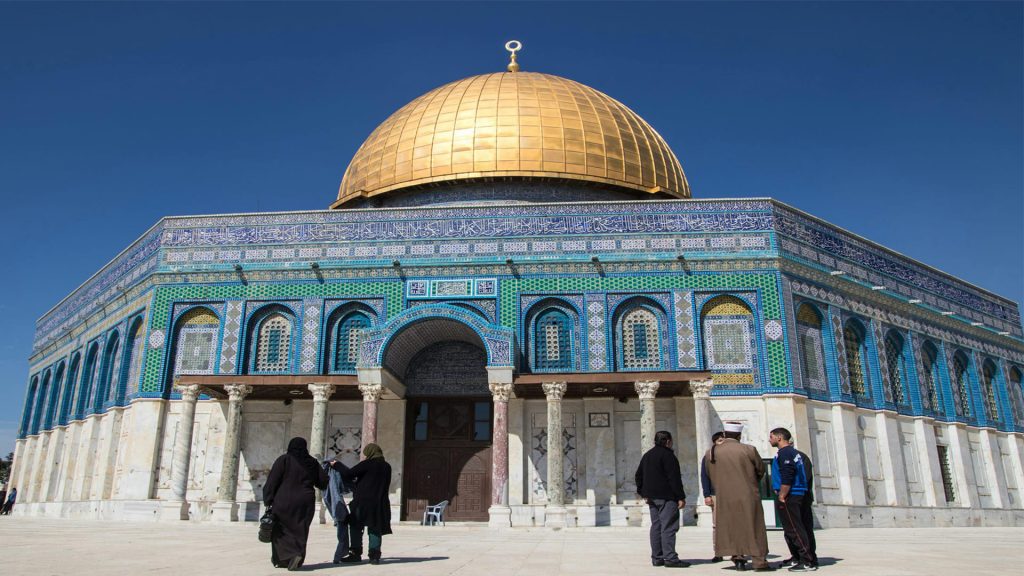
Al-Aqsa Mosque and the Dome of the Rock
The Al-Aqsa compound in Jerusalem, known to Muslims as Al-Haram al-Sharif, is the third holiest site in Islam after Mecca and Medina. It was the first direction of prayer (qibla) for Muslims before the qibla changed toward the Kaaba in Mecca. The Dome of the Rock, completed in 691 CE under the Umayyad caliph Abd al-Malik, stands on the same platform. Read more in our guide to Al-Aqsa Mosque.
The Ibrahimi Mosque in Hebron
The Ibrahimi Mosque, also called the Cave of the Patriarchs, is traditionally believed to hold the tombs of Prophet Ibrahim (Abraham) and his family. It is sacred to both Muslims and Jews and is divided between the two communities for worship.
What the Quran and Hadith Say
The Quran refers to Al-Aqsa in Surah Al-Isra (17:1), which describes the night journey of the Prophet Muhammad (peace be upon him) from the Sacred Mosque to "the farthest mosque", whose surroundings Allah blessed. The Prophet also said that journeys should be made specially to three mosques only: Al-Masjid al-Haram, his own mosque in Medina and Al-Aqsa (Sahih al-Bukhari 1189, Sahih Muslim 1397).
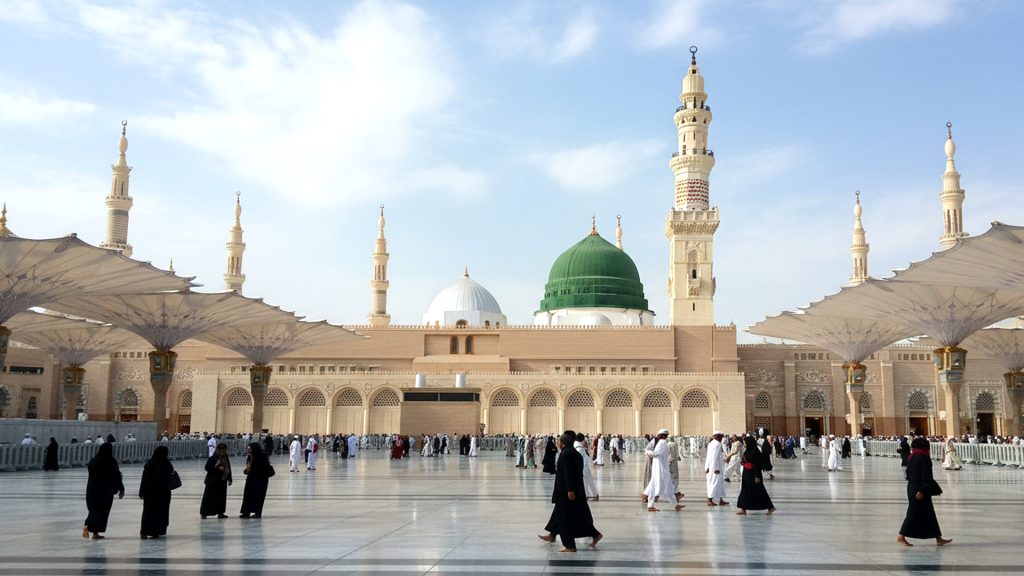

For related reading, see our guides to Mecca and Madinah.
A Short History of Islam in Palestine
Early Islamic Period

Muslim forces entered Jerusalem in 637 CE, when the caliph Umar ibn al-Khattab accepted the city's surrender from its Christian patriarch under a pact that guaranteed safety for people and churches. Over time Arabic language and Islam became dominant across the region.
Crusaders, Saladin and the Ottomans
Crusader armies captured Jerusalem in 1099. Salah ad-Din (Saladin) retook it in 1187. After centuries under the Mamluks, the Ottoman Empire ruled Palestine from 1517 until World War I, and Ottoman rule shaped its religious institutions and endowments (waqf).
Mandate, Nakba and Occupation
Britain governed Palestine from the 1920s until 1948. The war of 1948, which Palestinians call the Nakba, displaced around 700,000 Palestinians. In 1967 Israel took control of the West Bank, East Jerusalem and Gaza. The Oslo agreements of the 1990s created the Palestinian Authority but did not resolve final status. A wider survey is available in our Islamic history section.
Muslim Religious Life in Palestine Today
Ramadan, Eid and Zakat

During Ramadan, families gather for iftar, mosques fill for night prayers and charity increases. Learn more about the meaning of Ramadan and zakat. Many Palestinians rely on aid, and zakat committees and charities provide food and support to families in need.
Access to Holy Sites
Access to Al-Aqsa is a major issue. Israeli authorities set age limits and permit rules for entry from the West Bank, and these restrictions vary depending on security conditions. Palestinians and many human rights groups call the limits a violation of religious freedom, while Israel says they are security measures. Gaza residents have faced even tighter limits on travel, including for Hajj and Umrah.
Education and Faith

Palestine has several Islamic universities and Sharia faculties, and the Palestinian Authority's Ministry of Awqaf and Religious Affairs oversees mosques in the West Bank. Qur'an memorization centers are popular across Gaza and the West Bank.

Challenges Facing the Muslim Population in Palestine
- Humanitarian crisis: The PCBS reports unemployment near 46 percent overall at the end of 2025, with a far higher rate in Gaza.
- Displacement: Tens of thousands in the West Bank and a majority of people in Gaza have been displaced at some point since 2023, according to UN and PCBS reports.
- Movement restrictions: Checkpoints, permits and the separation barrier limit travel, trade and worship.
- Uncertain political future: Peace talks and governance of Gaza remain unresolved.
Readers should always check the latest reports from the UN's humanitarian office (OCHA) and the PCBS, since conditions change quickly.
Key Takeaways
- The Muslim population in Palestine is about 98 percent of Palestinians in the West Bank and Gaza, roughly 5.4 million people.
- The total Palestinian population in the State of Palestine was about 5.56 million at the end of 2025.
- Palestinian Muslims are overwhelmingly Sunni, and Christians are roughly 1 percent.
- Percentages differ because some sources count Israeli settlers in the West Bank.
- Al-Aqsa is the third holiest site in Islam and central to Palestinian Muslim identity.
Trusted Sources and Further Reading
- Palestinian Central Bureau of Statistics (PCBS)
- CIA World Factbook: West Bank
- CIA World Factbook: Gaza Strip
- Minority Rights Group: Palestine
- UN OCHA occupied Palestinian territory
Note: Population and religion figures are estimates, they differ by source and definition, and conditions in Gaza and the West Bank are changing quickly. Always verify with the latest official and UN data.
Frequently Asked Questions
What is the Muslim population in Palestine in 2026?
About 98 percent of Palestinians in the West Bank and Gaza are Muslim. With a population of about 5.56 million at the end of 2025 (PCBS), that is roughly 5.4 million Muslims.
What percentage of Palestine is Muslim?
Around 98 to 99 percent of Palestinians are Muslim. If Israeli settlers in the West Bank are counted, Muslims are about 80 to 85 percent of the West Bank population.
Are Palestinians Sunni or Shia?
Almost all Palestinian Muslims are Sunni, with the Shafi'i school the most common. Shia communities are negligible.
How many Palestinians live in Gaza and the West Bank?
The PCBS estimates about 3.43 million in the West Bank and 2.13 million in Gaza at the end of 2025.
How many Palestinians live worldwide?
The PCBS estimates about 15.5 million, with about 7.4 million in historic Palestine and about 8.1 million in other countries.
What percentage of Palestinians are Christian?
Roughly 1 percent, mostly Greek Orthodox, living in places such as Bethlehem, Ramallah, Jerusalem and Gaza City.
Why is Al-Aqsa important to Muslims?
It was the first qibla, it is mentioned in Surah Al-Isra, and it is the third holiest site in Islam after the Sacred Mosque in Mecca and the Prophet's Mosque in Medina.
Why do population numbers for Palestine differ?
Sources define Palestine differently, count settlers or exclude them, and use different survey years. War and displacement in Gaza also make counting harder.
Is Palestine a Muslim country?
Palestinians are overwhelmingly Muslim, and the Palestinian Basic Law names Islam as the official religion while guaranteeing the sanctity of other heavenly religions.
How does the Muslim population in Palestine compare with Indonesia?
Indonesia has more than 230 million Muslims, while Palestine has around five million. However, Palestine's religious importance is far larger than its population. See our guide to the Muslim population in Indonesia.