
Muslim Population by Country 2026: 10 Shocking Facts
Muslim population by country 2026 is a topic that mixes faith, demography and daily life, and the numbers are changing faster than most people expect. This guide gives you the latest figures, the top countries, the regional picture and the 2070 outlook in plain language. It leans on Pew Research Center’s newly released projections of November 18, 2026, and we explain every limit of the data so you can trust what you read.
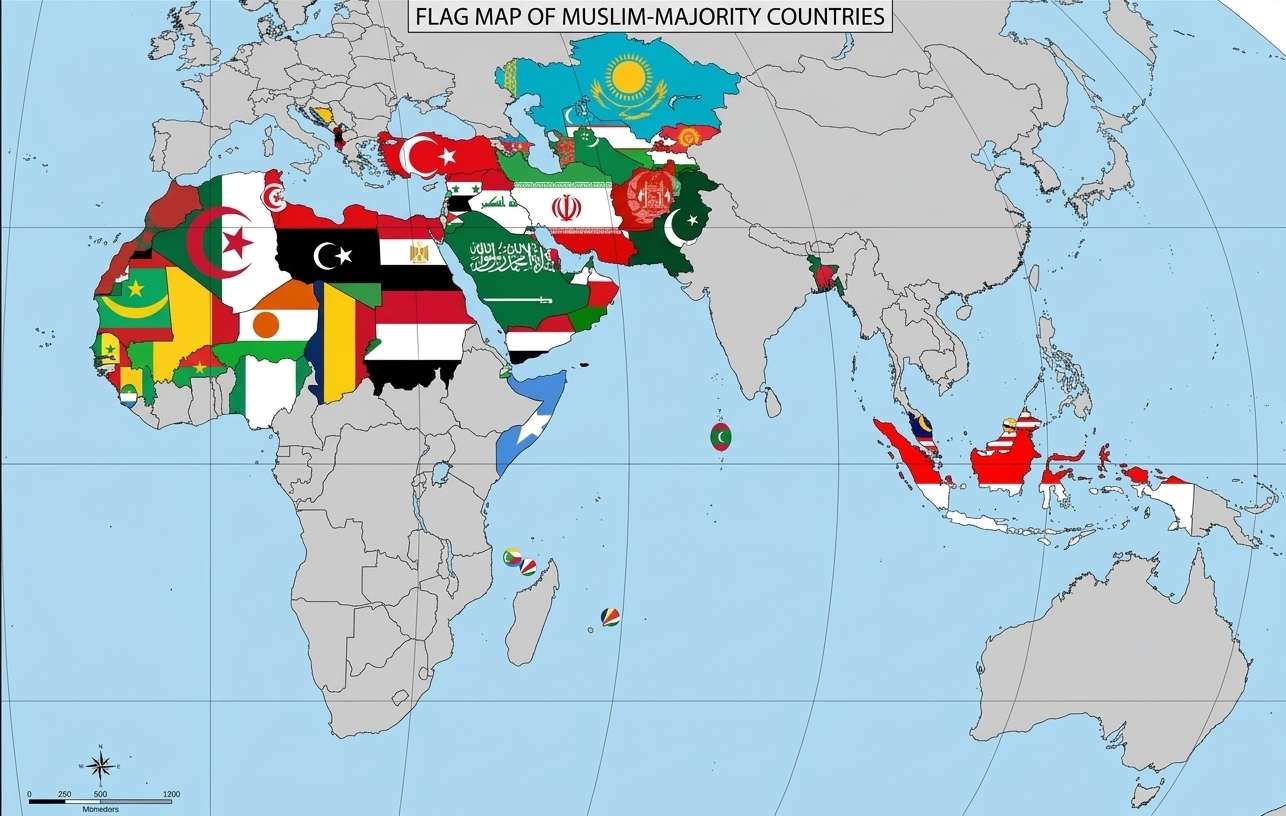
- Roughly one in four people worldwide is Muslim, a little over 2 billion people in 2026.
- Indonesia, Pakistan, India, Bangladesh and Nigeria hold nearly half of all Muslims.
- Pakistan is projected to overtake Indonesia as the largest Muslim population by 2070.
- Muslims are projected to grow 80 percent by 2070, against 11 percent for everyone else.
- Muslims are projected to pass Christians as the largest religious group by 2035.
Muslim population by country 2026: The Big Picture
Live population counters estimate that about 2.07 billion people identify as Muslim in 2026, which is over 25 percent of a world population near 8.27 billion. That makes Islam the second largest religion after Christianity, and the fastest growing major religion.
Pew’s most recent baseline is 2020, and it is the most rigorous count available. Pew builds its figures from national censuses and large surveys, then applies age, fertility, migration and religious switching data. You can explore the full dataset in the Pew data explorer.
Think of it like a weather forecast. The 2020 count is the measured temperature, the Muslim population by country 2026 figure is today’s estimate, and 2070 is a long range outlook with a margin of error.
How the Numbers Are Calculated
Demographers start with people grouped by age and sex. Every five years they add expected births and subtract expected deaths, then adjust for migration. Pew projects 201 countries and territories, covering 99.98 percent of the world’s population.
This method is called cohort component projection. It is the standard approach used by the United Nations, and you can compare it with the official UN World Population Prospects.
Why Sources Disagree
If you search for Muslim population by country 2026, you will see different totals. That is normal, and it comes from three things:
- Base year: a 2020 survey and a 2026 estimate cannot match.
- Definitions: some count only practicing Muslims, others count everyone raised in the faith.
- Data gaps: a few countries have not run a religion census in decades.
A practical example: Pew puts Indonesia at 239 million in 2020, while a 2026 aggregator shows about 247 million. The gap of 8 million is mostly six years of growth, not a disagreement.
Top Countries in the Muslim population by country 2026 Rankings
Nearly half of the world’s Muslims lived in just five countries in 2020. The table below shows Pew’s baseline and the 2026 estimates from a live counter where available. Use the 2020 column for citations and the 2026 column as a directional guide to Muslim population by country 2026.
| Rank | Country | Pew 2020 (actual) | 2026 estimate (approx.) |
|---|---|---|---|
| 1 | Indonesia | 239 million | about 247 million |
| 2 | Pakistan | 227 million | about 246 million |
| 3 | India | 213 million | about 226 million |
| 4 | Bangladesh | 151 million | about 162 million |
| 5 | Nigeria | 120 million | growing fast |
2026 estimates come from a live population counter (timesprayer.com) and are approximate. Pew’s 2020 figures are the research grade baseline.
2020 actual2070 projected
Chart: Largest Muslim populations in millions. Source: Pew Research Center, November 2026.
1. Indonesia
Indonesia is the largest Muslim nation, with Islam practiced by the clear majority of its people across thousands of islands. Its fertility rate has fallen, so growth is slowing. That is exactly why Pew expects Pakistan to pass it.
2. Pakistan
Pakistan is only a few percentage points behind Indonesia in the Muslim population by country 2026 ranking. A young population and higher fertility keep it growing. Pew projects 461 million Muslims in Pakistan by 2070, about 13 percent of all Muslims worldwide.
3. India
India has the world’s largest Muslim minority and the third largest Muslim population overall. Pew projects 334 million Muslims by 2070, which would place India second in the world. Muslims remain a minority in India throughout that period.
4. Bangladesh
Bangladesh is a key name in Muslim population by country 2026. It is densely populated and overwhelmingly Muslim. It ranks fourth with 151 million in 2020, and it is also a major source of Muslim migration to the Gulf, Europe and North America.
5. Nigeria
Nigeria is the Muslim population by country 2026 story to watch. With 120 million Muslims in 2020 and a very young population, it is projected to climb to third place by 2070. Another Sub Saharan country, Ethiopia, and also Afghanistan are projected to join the top 10 by 2070.
What about Egypt, Iran and Turkey?
These countries are large Muslim populations, yet their growth is slower because fertility is lower and their populations are older. They remain important, but they do not change the top five order.
Muslim Majority Countries in 2026
In the Muslim population by country 2026 picture, Pew counted 53 countries and territories with Muslim majorities in 2020. All of them are projected to stay that way in 2070, and Ivory Coast is projected to join, making 54.
Three useful facts about Muslim population by country 2026 and majority status:
- In 2070, 35 places are projected to be at least 90 percent Muslim.
- Only seven Muslim majority countries will have 100 million or more residents: Pakistan, Nigeria, Indonesia, Bangladesh, Egypt, Sudan and Turkey.
- In 92 countries and territories, Muslims will still be under 5 percent of the population in 2070.
Lebanon is the only mainly Arabic speaking country where the Muslim share is expected to rise substantially. Muslims already make up 95 percent or more in most other Arabic speaking countries.
For context on how these societies practice the faith day to day, see our guides to the Five Pillars of Islam and Islamic culture.
Muslim population by country 2026 by Region
Muslim population by country 2026 also varies sharply by region. About six in ten Muslims lived in Asia and the Pacific in 2020. The Middle East and North Africa had 20 percent, and Sub Saharan Africa had 18 percent. About 2 percent lived in Europe.
| Region | Share of world Muslims, 2020 | Share, 2070 (projected) |
|---|---|---|
| Asia and the Pacific | 59% | 50% |
| Middle East and North Africa | 20% | not stated here |
| Sub Saharan Africa | 18% | 27% |
| Europe | about 2% | about 2% |
Sub Saharan Africa: The Growth Engine
For Muslim population by country 2026 watchers, this is the biggest shift: Muslims in Sub Saharan Africa are projected to grow from 369 million to 980 million by 2070. Their median age is only 17, and their fertility rate is 5.1 children per woman. Four countries have rates above 6: the Democratic Republic of the Congo, Somalia, Chad and Niger.
Asia Pacific: Still the Heartland
Asia’s share of world Muslims slips from 59 to 50 percent, but the actual number keeps growing. Within the region, Muslims rise from 26 to 37 percent of the population.
North America: Fastest Percentage Growth
Muslims in North America are projected to more than triple, from 6 million to 20 million. Migration drives most of that increase.
Why the Numbers Are Growing
When you read any Muslim population by country 2026 report, four forces explain the trend.
Youth
Youth is the first reason Muslim population by country 2026 keeps rising. Six in ten Muslims worldwide are under 30, while fewer than half of non Muslims are. A young population has many people about to enter their childbearing years, and that builds momentum.
Fertility
Muslim women average 3.1 children globally, against 2.0 for non Muslims. Replacement level is about 2.1. Of 119 places with data, 74 have Muslim fertility at or above that level.
Migration
More than 112 million Muslims are expected to move between regions by 2070. Europe gains the most, with 27 million arriving and 2 million leaving. Asia Pacific has a net loss of 27 million.
Retention
About 99 percent of people raised Muslim still identify as Muslim as adults. Retention is lower in Europe (93 percent) and North America (85 percent). If global retention fell toward those levels, growth would slow.
Chart: Projected population growth, 2020 to 2070. Source: Pew Research Center, November 2026.
Muslim Population by Country 2026 in Europe and North America
In Muslim population by country 2026, Western countries rank low in absolute numbers, but they attract the most debate. No country in North America or Europe was in the top 10 in 2020, and none will be in 2070.
- Europe: the Muslim share is projected to rise from 6 to 13 percent. Without any migration it would be about 9 percent.
- France and Sweden: each is projected to gain about 11 percentage points.
- Albania: the largest projected gain at 16 points.
- United States: up by 9 million, reaching about 4 percent of the population.
The practical lesson is that projections are conditional. They assume recent migration and fertility trends continue, and policy changes, wars or economic shifts can move them.
Suriname is the only country projected to see a substantial decline, about 6 points.
Muslim population by country 2026 and the Road to 2070
| Indicator | Pew projection |
|---|---|
| Global Muslims in 2070 | 3.6 billion (36% of world) |
| Growth 2020 to 2070 | Muslims +80%, non Muslims +11% |
| Passes Christians | by 2035 |
| Largest Muslim country | Pakistan, 461 million |
| Second largest | India, 334 million |
| Third largest | Nigeria |
| Muslim majority countries | 54 (up from 53) |
Any long range view of Muslim population by country 2026 comes with limits. Pew warns that its results are not a prediction of everything that could happen. Wars, epidemics, disasters and social change are not modelled. Treat 2070 as a scenario, not a guarantee.
Pew’s own commentary explains why growth may look different from the headlines. Read the full Pew analysis of the global Muslim population and its sortable country table.
Quran and Hadith Guidance on Human Diversity
Numbers tell us how many Muslims there are. Islam’s sources tell us how to think about them. Three references are especially relevant.
يَا أَيُّهَا النَّاسُ إِنَّا خَلَقْنَاكُم مِّن ذَكَرٍ وَأُنثَىٰ وَجَعَلْنَاكُمْ شُعُوبًا وَقَبَائِلَ لِتَعَارَفُوا
Allah tells humanity that He created people as male and female and made them into nations and tribes so that they may know one another. This verse is a reminder that diversity is by design.
Quran, Surah Al Hujurat 49:13The Quran also describes the Muslim community as a balanced, moderate nation that bears witness over humanity. Size is never the measure of virtue in this verse, balance is.
Quran, Surah Al Baqarah 2:143Allah also lists the diversity of languages and colors among His signs, which supports a respectful reading of the global Muslim community in all its variety.
Quran, Surah Ar Rum 30:22On hadith, the Prophet Muhammad ﷺ said that Allah does not show mercy to the one who does not show mercy to people (Sahih Bukhari 7376, Sahih Muslim 2319). Another narration records his instruction to convey knowledge from him even if it is a single verse (Sahih Bukhari 3461).
The lesson is clear: population data is a tool for understanding and service, not for pride or fear. Our readers can explore more through Islam Religion, the history of Islam and the 99 Names of Allah.
How to Use Muslim population by country 2026 in Real Life
For Students and Researchers
When you write about Muslim population by country 2026, cite Pew’s 2020 baseline for actual counts, and label 2026 numbers as estimates. Always write the base year next to the number, such as “239 million (Pew, 2020).”
For Journalists and Writers
Never place a live counter figure and a census figure in the same sentence without explaining the difference. Link to the primary source so readers can verify it.
For Mosques and Community Planners
Local demographics matter more than national totals. If a city’s Muslim population is young, plan for schools, weekend programs and youth spaces. A growing share of older members needs accessible facilities.
For Charities and Zakat Planning
Knowing where Muslim populations are youngest and fastest growing helps direct education and health funding. Muslims who give Zakat can use our free Zakat calculator to work out their obligation, and learn about Hajj and Ramadan through our guides.
For Travellers
If you travel to Muslim majority countries, check local prayer times and customs in advance.
Myths About Muslim population by country 2026
Searches for Muslim population by country 2026 often come with assumptions. Here are the four most common ones, checked against the data.
Myth 1: The Muslim population is one uniform bloc
The data behind Muslim population by country 2026 shows Muslims live in nearly every country and speak hundreds of languages. Most Muslims are not Arab, and the largest populations are in South and Southeast Asia.
Myth 2: Muslims will soon be a majority in the West
The data says otherwise. Under Pew’s main projection, Muslims are projected at about 4 percent of the United States and 13 percent of Europe in 2070.
Myth 3: Growth is mostly from conversion
Pew finds that natural increase, meaning births minus deaths, is the main driver. Religious switching has little impact on the global total because retention is about 99 percent.
Myth 4: Growth will continue at the same pace forever
Fertility is declining in many Muslim majority countries, including Indonesia and Iran. Pew’s model already accounts for slowing growth, which is why the rate eases over time.
Frequently Asked Questions About Muslim population by country 2026
What is the Muslim population by country 2026 at a glance?
Global estimates for 2026 sit a little above 2 billion Muslims, roughly one in four people on Earth. Indonesia, Pakistan, India, Bangladesh and Nigeria hold the largest populations, and nearly half of all Muslims live in those five countries.
Which country has the largest Muslim population in 2026?
Indonesia still has the largest Muslim population. Pew counted 239 million Muslims there in 2020, and aggregator estimates for 2026 put the figure near 247 million. Pakistan is very close behind and is projected to overtake Indonesia by 2070.
Which country has the most Muslims as a share of its population?
Many countries are close to 100 percent Muslim, including Afghanistan, Saudi Arabia, Somalia, Yemen, Iran and several North African states. Pew reports that 53 countries and territories were Muslim majority in 2020.
Is India among the top three countries for Muslims?
Yes. India has the world’s third largest Muslim population, about 213 million in Pew’s 2020 baseline. India is also the largest Muslim population living in a country where Muslims are a minority, and it is projected to rank second by 2070.
How fast is the global Muslim population growing?
Pew projects 80 percent growth between 2020 and 2070, compared with 11 percent for non Muslims. The main drivers are a young age profile and a fertility rate of about 3.1 children per woman.
Will Islam become the largest religion in the world?
Pew projects that Muslims will surpass Christians as the world’s largest religious group by 2035. By 2070 Muslims are projected to number 3.6 billion, about 36 percent of the world.
How many Muslims live in the United States and Europe?
Muslims remain a small minority in the United States, projected at about 4 percent of the population by 2070. In Europe the Muslim share is projected to roughly double from 6 percent to 13 percent, with migration playing a large role.
Why do different websites show different Muslim population numbers?
Sources use different base years, definitions and methods. Pew uses census and survey data with demographic modelling, while live counters extrapolate growth rates. Treat any single number as an estimate and always check the base year.
Conclusion: What Muslim population by country 2026 Tells Us
The most useful reading of Muslim population by country 2026 is this: Muslims number a little over 2 billion, they are concentrated in Asia and Africa, and the center of gravity is shifting toward Pakistan and Sub Saharan Africa. Always compare sources by base year, and trust primary research over unsourced lists.
We will update this page as new Pew and UN data arrive. Bookmark it, and explore more on Islamic Info Center.
Sources and Further Reading
- Pew Research Center: The Future of the Global Muslim Population, 2020 to 2070 (Nov 18, 2026)
- Pew methodology for the Future of World Religions study
- Pew: How the global religious landscape changed from 2010 to 2020
- United Nations World Population Prospects
- CIA World Factbook country data
- TimesPrayer live Muslim population counter (2026 estimates, approximate)