
Embarking on the sacred journey of pilgrimage requires absolute clarity, precision, and deep spiritual focus. Understanding the core Hajj Rituals Step by Step guarantees that every ancient rite—from entry into Ihram to the final farewell circumambulation—is executed with valid legal accuracy (Fiqh) and perfect spatial confidence.
As the fifth pillar of Islam, this obligatory devotion demands immense physical endurance alongside profound meta-cognitive awareness. Our scholarly team at the Islamic Info Center has assembled this exhaustive guide to simplify navigation across the global holy sanctuaries.
"Pilgrimage to the House is a duty owed to Allah by all people who are able to undertake it."
— Surah Ali 'Imran [3:97], The Holy Qur'an
The Preparation Phases & Essential Pre-Arrival Rules
Before stepping onto the planes heading towards Makkah, you must select your functional method of intent. There are three legally defined variations of pilgrimage: Hajj al-Tamattu (combining independent Umrah and Hajj stages), Hajj al-Qiran (continuous joint state), and Hajj al-Ifrad (standalone Hajj execution). Most contemporary international travelers choose Tamattu due to its flexible breaks from physical restrictions.
Establishing Holy Intent
You must pass into the state of Ihram before crossing specific physical geographic borders around Makkah, known as the Miqat lines. For example, flights landing at Jeddah require passengers to transition while mid-air.
Sartorial and Internal Codes
Men must wear two seamless unstitched white cloth sheets. Women must maintain clean, standard modest attire leaving faces and hands uncovered. Severe prohibitions against scent use, hair cutting, and intimacy begin instantly.
Hajj Rituals Step by Step: Day-by-Day Complete Breakdown
08 Day 1: 8th Dhul Hijjah – Yawm at-Tarwiyah (The Day of Refreshment)
The true rites of the macro-pilgrimage commence on the 8th day of the sacred lunar month of Dhul Hijjah. If you are completing Hajj al-Tamattu, you will re-enter the consecrated state of Ihram from your accommodation zone within Makkah after making the formal internal declaration of intent (Niyyah).
From Makkah, millions of pilgrims migrate concurrently eastward toward the valley of Mina, situated roughly 8 kilometers from the central holy mosque. In Mina, you will spend the afternoon, evening, and subsequent night resting inside massive climate-controlled white tent cities.
 Visual tracking chart illustrating structural transitions across the Mina, Arafat, and Makkah spatial boundaries.
09 Day 2: 9th Dhul Hijjah – Day of Arafat & Muzdalifah Overnight
The morning sun marks the transition to the single most paramount day of the entire pilgrimage sequence. Missing the absolute temporal window of the plain of Arafat completely invalidates your performance.
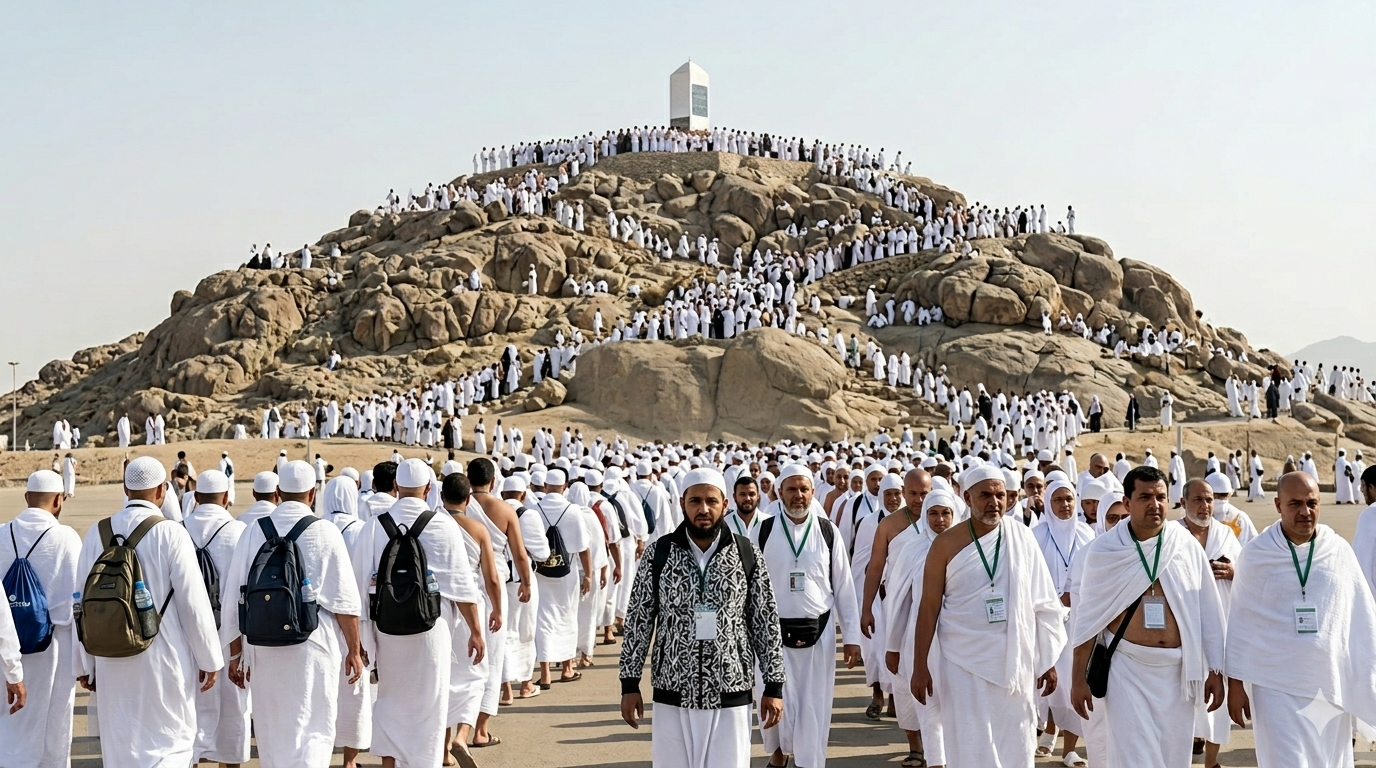 The gathering at Mount Arafat, where pilgrims dedicate their entire day to intense supplication and devotion.
The Standing at Mount Arafat (Wuquf)
Pilgrims arrive by train, foot, or bus to the plains of Arafat before afternoon noon hours (Zawal). You join the ocean of humanity standing in prayer, raising open hands to beg for divine absolute forgiveness until dusk. According to rigorous legal rulings supported by the Saudi Ministry of Hajj and Umrah, your presence anywhere inside the mapped perimeter of Arafat fulfills this foundational mandate.
The Sunset Departure to Muzdalifah
As sunset sounds, the crowds evacuate instantly without performing Maghrib prayers. You journey down to the open plains of Muzdalifah. Here, under the open stellar canopy, you combine the delayed evening prayers and gather between 49 to 70 small pebble stones from the desert sands for subsequent stoning stages.
10 Day 3: 10th Dhul Hijjah – Eid al-Adha, Jamarat Stoning, and Sacrifices
Day 10 requires rapid execution of multiple layered rites. Pilgrims return to Mina before dawn breaks to engage in the first phase of the symbolic stoning execution at the massive Jamarat complex.
Day 10 Strict Sequence Matrix
-
1
Stoning Jamarat al-Aqaba: You throw exactly 7 gathered stones at the largest pillar structure while reciting Takbeer.
-
2
Animal Sacrifice (Hadi): A ritual livestock purchase is processed via digital platforms to feed disadvantaged families worldwide.
-
3
Shaving or Trimming (Halq/Taqsier): Men shave their heads clean or cut hair uniformly; women cut a small fingertip length of hair. You can now step out of Ihram garments into regular apparel.
11 Days 4–6: 11th, 12th, and 13th Dhul Hijjah – Ayyam at-Tashreeq
Following the joyful morning celebrations of Eid, you remain stationed inside the Mina valley lines for another two to three consecutive days. Each afternoon, you must walk to the grand multi-tiered Jamarat facility to cast 7 pebbles at all three distinct structural targets: the small (Sughra), medium (Wusta), and large (Aqaba) pillars, summing up to 21 stones daily.
Once your stoning obligations wrap up on your selected exit date, you return permanently to the center of Makkah to complete the Tawaf al-Ifadah (essential Hajj circumambulation) and the subsequent walking lanes between Safa and Marwah hills.
 The historical gallery between the hills of Safa and Marwah where pilgrims perform the ritual walk (Sa'ee).
Comparative Summary Matrix of Daily Pilgrim Milestones
Swipe horizontally if viewing on a smaller mobile screen monitor to track the location shift dynamics.
| Lunar Date | Ritual Phase Name | Primary Physical Location | Key Obligation |
|---|---|---|---|
| 8 Dhul Hijjah | Yawm at-Tarwiyah | Makkah to Mina Valley | Entering Ihram state, prayer preparation |
| 9 Dhul Hijjah | Day of Arafat | Plain of Arafat & Muzdalifah | Wuquf standing prayer, collecting stones |
| 10 Dhul Hijjah | Yawm an-Nahr (Eid) | Mina, Jamarat & Makkah Grand Mosque | Major stoning, hair trimming, sacrifice processing |
| 11-13 Dhul Hijjah | Ayyam at-Tashreeq | Mina Complex and Final Makkah limits | Triple pillar stoning, Tawaf al-Wada (Farewell) |
Frequently Asked Questions Regarding Hajj Rites
Q. What are the 3 main types of Hajj?
The three standard legal types are Hajj al-Tamattu (performing Umrah then breaking Ihram before Hajj, highly recommended), Hajj al-Qiran (combining both without any garment transition break), and Hajj al-Ifrad (performing solo pilgrimage without Umrah components).
Q. Can a woman perform Hajj without a Mahram guardian?
Yes. Under modernized policies structured directly by the modern Saudi regulatory systems, women are completely permitted to complete legal registration and travel safely without a male relative, provided they journey within certified official tourist group frameworks.
Q. What happens if a pilgrim misses the standing at Arafat?
If you fail to stand or stay inside the borders of Arafat during the prescribed hours of the 9th of Dhul Hijjah before the dawn of Eid morning, your entire Hajj is declared completely void. It cannot be fixed with a compensation penalty sacrifice.