
Dua Before Sleeping: 7 Powerful Duas for a Peaceful Night
Dua before sleeping is one of the simplest and most beautiful habits a Muslim can build. It takes only a few minutes, yet it turns the end of your day into an act of worship, protection and trust in Allah. In this guide you will find the authentic duas the Prophet Muhammad ﷺ recited at night, each with Arabic text, transliteration, meaning and source, plus practical steps you can start tonight.

Why the Dua Before Sleeping Matters
Sleep is described in the Quran as a sign of Allah's mercy. Allah says that He takes the souls at death and also takes the souls of those who have not died during their sleep (Surah Az Zumar 39:42). Every night, then, is a small reminder that our life is in His hands.
That is why the Prophet ﷺ never treated bedtime casually. He prepared for sleep with remembrance, and he taught his companions to do the same. A consistent dua before sleeping brings three clear benefits:
- Protection: Authentic narrations connect certain night recitations with Allah's guard until morning.
- Calm: Ending the day with dhikr replaces worry and screen noise with stillness.
- Reward: A simple Sunnah repeated daily becomes a steady source of good deeds.
Sunnah Steps to Follow Before You Sleep
The dua before sleeping works best as part of a short routine. These steps come from authentic hadith.
1. Make wudu
The Prophet ﷺ advised, "When you go to your bed, perform wudu as you do for prayer, then lie on your right side" (Sahih al Bukhari 247, Sahih Muslim 2710). Sleeping in a state of purity is a gentle way to close the day.
2. Dust the bed and lie on your right side
He also taught that a person should shake the bed with the edge of the garment and say the name of Allah (Sahih al Bukhari 6320). Lying on the right side is the recommended position, with the right hand under the cheek.
3. Recite the dua before sleeping
Choose from the seven duas below. Even if you begin with only one or two, consistency matters more than quantity.
4. Make your last words dhikr
The Prophet ﷺ wanted these remembrances to be the last words a person says before sleep. Put the phone away, lower the lights and finish with the words of Allah.
7 Duas to Recite at Night
Below is the complete collection. Each dua before sleeping includes its source so you can verify it yourself on trusted platforms such as Sunnah.com.
1. The Core Dua: Allahumma Bismika
Before you sleep, recite the following:
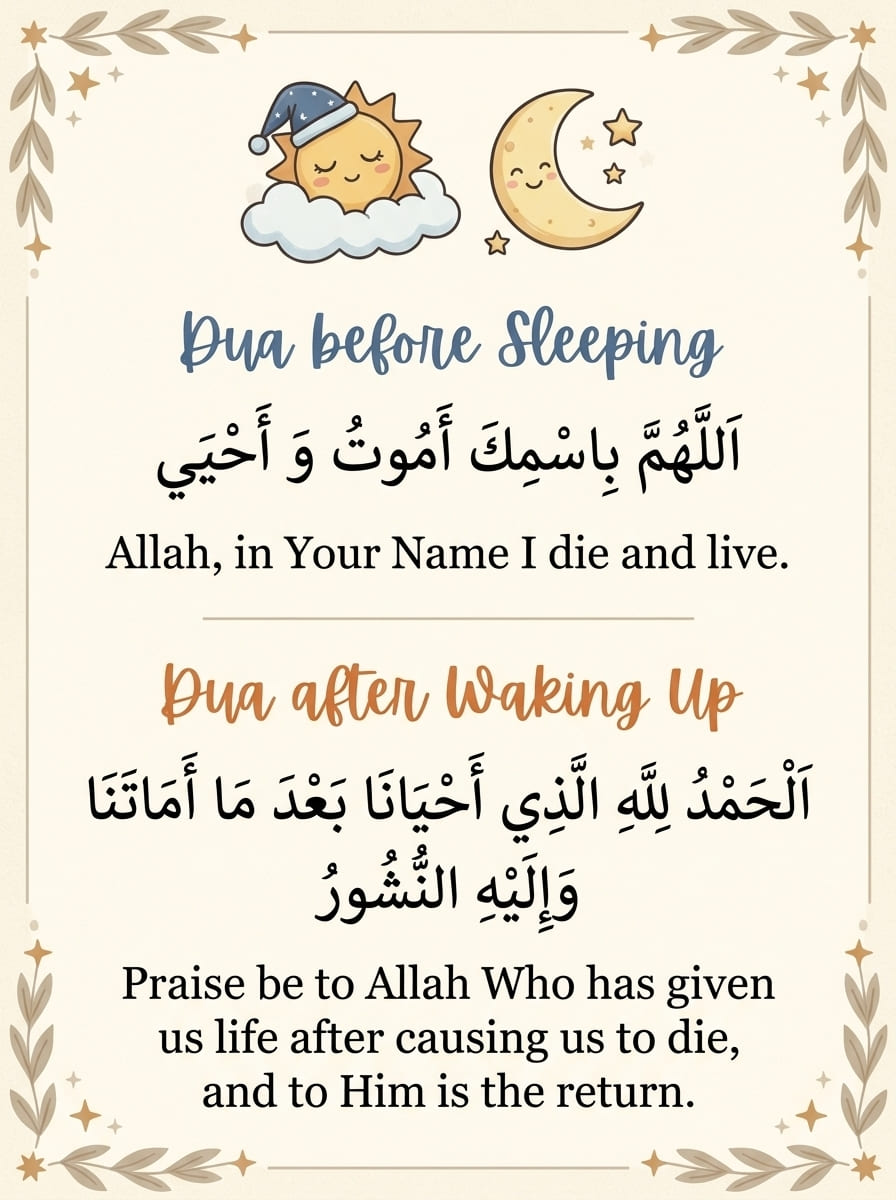
اللَّهُمَّ بِاسْمِكَ أَمُوتُ وَأَحْيَا
Transliteration: Allahumma bismika amutu wa ahya
Translation: O Allah, with Your name I die and I live.
Source: Sahih al Bukhari 6324. Hudhayfah reported that the Prophet ﷺ said this when he went to bed.
This is the shortest and most widely taught dua before sleeping. If you are teaching a child, begin here.
2. Protection from the Day of Judgment
اللَّهُمَّ قِنِي عَذَابَكَ يَوْمَ تَبْعَثُ عِبَادَكَ
Allahumma qini adhabaka yawma tab'athu ibadak.
Meaning: O Allah, protect me from Your punishment on the day You resurrect Your servants.
Source: Sunan Abi Dawud 5045 and Jami at Tirmidhi 3398. The Prophet ﷺ placed his right hand under his cheek and said this three times.
3. Ayat al Kursi (Surah Al Baqarah 2:255)
اللَّهُ لَا إِلَٰهَ إِلَّا هُوَ الْحَيُّ الْقَيُّومُ ۚ لَا تَأْخُذُهُ سِنَةٌ وَلَا نَوْمٌ
Allahu la ilaha illa huwal hayyul qayyum, la ta'khudhuhu sinatun wa la nawm...
Meaning: Allah, there is no god but Him, the Ever Living, the Sustainer of all. Neither drowsiness nor sleep overtakes Him...
Source: Sahih al Bukhari 2311. Whoever recites it when going to bed will have a protector from Allah, and no devil will come near until morning. Recite the full verse.
You can read the verse with translation on Quran.com.
4. The Last Two Verses of Surah Al Baqarah (2:285 to 286)
The Prophet ﷺ said that whoever recites the last two verses of Surah Al Baqarah at night, they will suffice him (Sahih al Bukhari 5009, Sahih Muslim 807). Scholars explain "suffice" as sufficing for protection or for the night prayer, and Allah knows best. These verses end with a powerful supplication for forgiveness and mercy, which makes them a perfect part of any dua before sleeping.
5. The Three Quls
Aisha (may Allah be pleased with her) reported that each night the Prophet ﷺ joined his palms, blew lightly into them, recited Surah Al Ikhlas, Al Falaq and An Nas, then wiped his hands over whatever parts of his body he could reach, starting with the head and face. He did this three times (Sahih al Bukhari 5017).
قُلْ هُوَ اللَّهُ أَحَدٌ
Qul huwa Allahu ahad.
Meaning: Say, "He is Allah, the One."
Surah Al Ikhlas 112:1. Recite the full three surahs.
6. The Dua of Entrusting Yourself to Allah
اللَّهُمَّ أَسْلَمْتُ نَفْسِي إِلَيْكَ، وَفَوَّضْتُ أَمْرِي إِلَيْكَ، وَوَجَّهْتُ وَجْهِي إِلَيْكَ، وَأَلْجَأْتُ ظَهْرِي إِلَيْكَ، رَغْبَةً وَرَهْبَةً إِلَيْكَ، لَا مَلْجَأَ وَلَا مَنْجَا مِنْكَ إِلَّا إِلَيْكَ، آمَنْتُ بِكِتَابِكَ الَّذِي أَنْزَلْتَ، وَبِنَبِيِّكَ الَّذِي أَرْسَلْتَ
Allahumma aslamtu nafsi ilayk, wa fawwadtu amri ilayk, wa wajjahtu wajhi ilayk, wa alja'tu zahri ilayk, raghbatan wa rahbatan ilayk, la malja'a wa la manja minka illa ilayk, amantu bikitabikal ladhi anzalt, wa binabiyyikal ladhi arsalt.
Meaning: O Allah, I submit myself to You, entrust my affairs to You, turn my face to You and rely on You, in hope and in fear of You. There is no refuge and no escape from You except to You. I believe in Your Book which You revealed and Your Prophet whom You sent.
Source: Sahih al Bukhari 247 and Sahih Muslim 2710. The Prophet ﷺ said that whoever says this and dies that night dies upon the fitrah.
7. Tasbih of Fatimah
The Prophet ﷺ taught his daughter Fatimah and her husband Ali (may Allah be pleased with them) a remembrance better than a servant to ease their tiredness (Sahih al Bukhari 3113, Sahih Muslim 2727).
سُبْحَانَ اللَّهِ ×٣٣ الْحَمْدُ لِلَّهِ ×٣٣ اللَّهُ أَكْبَرُ ×٣٤
SubhanAllah (33), Alhamdulillah (33), Allahu Akbar (34).
Meaning: Glory be to Allah, all praise is for Allah, Allah is the Greatest.
Quick Reference Table
| Dua | Best for | Time needed |
|---|---|---|
| Allahumma Bismika | Beginners and children | 10 seconds |
| Ayat al Kursi | Protection through the night | 1 minute |
| Three Quls | Daily Sunnah routine | 2 minutes |
| Tasbih of Fatimah | Tiredness and gratitude | 3 minutes |
Dua When You Wake Up
The routine closes the loop with a short thanks in the morning. When the Prophet ﷺ woke, he would say:
الْحَمْدُ لِلَّهِ الَّذِي أَحْيَانَا بَعْدَ مَا أَمَاتَنَا وَإِلَيْهِ النُّشُورُ
Alhamdu lillahil ladhi ahyana ba'da ma amatana wa ilayhin nushur.
Meaning: All praise is for Allah who gave us life after causing us to die, and to Him is the resurrection.
Source: Sahih al Bukhari 6312.
How to Build a Lasting Dua Before Sleeping Habit
Start small and stay consistent
Do not try to memorize all seven at once. Learn Allahumma Bismika in week one, add Ayat al Kursi in week two, and continue from there. A short dua before sleeping done every night is better than a long one done rarely.
Practical examples that work
- Write it down: Keep a small card with the Arabic and transliteration beside your bed.
- Link it to a cue: Recite immediately after you switch off the light.
- Use the phone wisely: Set a gentle reminder, then place the phone across the room.
- Teach it to children: Recite together as a family. Children learn quickly through repetition.
A sample five minute routine
Wudu, dust the bed, lie on your right side, recite Ayat al Kursi, the Three Quls and Allahumma Bismika. Many people find that their mind settles much faster than when they scroll before bed.
Good sleep and faith work together
Islam values rest as a right of the body. Health bodies such as the Sleep Foundation also stress calm routines and less screen time at night. A quiet routine built on remembrance fits both. Note that duas are acts of worship and trust, not a replacement for medical care. If you suffer from long term sleeplessness, please consult a qualified doctor.
Continue learning
Explore more on our website: Islamic Info Center home, our daily duas collection, and morning and evening adhkar. For another trusted reference, see the guide on duas for sleeping by Islamic Relief UK.
Frequently Asked Questions About Dua Before Sleeping
What is the dua before sleeping?
The most common is "Allahumma bismika amutu wa ahya", meaning "O Allah, with Your name I die and I live" (Sahih al Bukhari 6324). It is often combined with Ayat al Kursi and the Three Quls.
Can I recite the dua before sleeping in English?
The Arabic words are the authentic text and carry the reward of recitation. However, if you do not yet know the Arabic, you may make dua in your own language while you learn. Aim to memorize the Arabic over time.
What if I forget to say the dua before sleeping?
There is no sin in forgetting. Simply recite it when you remember, even if you are already in bed. You can also say it when you wake up in the night.
Is it necessary to make wudu before sleeping?
It is a recommended Sunnah, not an obligation. Making wudu is a beautiful practice, and the hadith in Sahih al Bukhari 247 encourages it.
How many times should I recite the three Quls?
The hadith in Sahih al Bukhari 5017 mentions reciting them and wiping the body, repeated three times.
The dua before sleeping is a small act with a great meaning. It reminds you each night that Allah is your Protector, your Sustainer and your final return. Begin with one dua tonight, add another next week, and let this Sunnah settle into your life. May Allah grant you peaceful nights and blessed mornings. Ameen.
Disclaimer: This article is for general educational purposes. For detailed rulings, please consult a qualified scholar.